


MEDICINE BALLS
One of the oldest and earliest pieces of equipment, the medicine ball, dates to ancient Greece.
At that time, medicine balls were made from pig bladders or animal skins that were filled with sand.
Back then, they were mostly tossed back-and-forth for fun, fitness, and sport, before being more prominently used for any real type of “training.”
Medicine balls didn’t really come into play or catch the attention of the public until the 1930s, when President Herbert Hoover and his staff were seen on the White House lawn playing a game called Hoover Ball.
The game looked like volleyball except that a heavy ball was thrown back and forth over the net and was presented as “the perfect prescription” for better health and wellness. And, obviously, that’s where the name MEDICINE BALL came from.
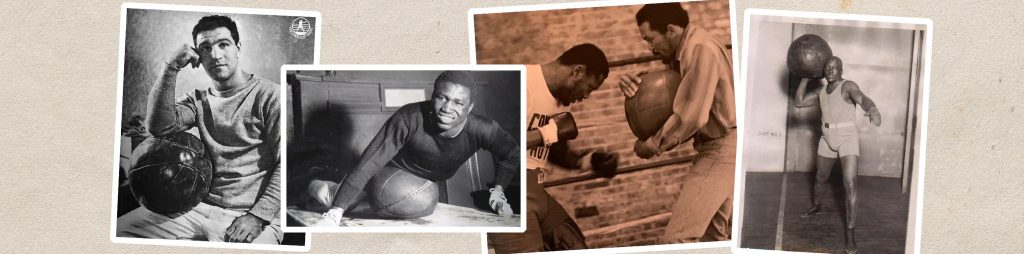
Anyway, after that, some of the earliest images and references of the use of medicine balls (in terms of them being used in boxing and for hardcore training) came about with Jack Johnson.He was an innovator who welcomed new ideas and was “a first” on many levels.
Since that time, nearly every recognizable fighter, from Sugar Ray Robinson to Sonny Liston, has had a medicine ball thrown at their midsection, tossed it back and forth to a partner, jumped with it, run with it, punched at it, or, in some way, incorporated it into their routine.
Now, more than ever, we understand how the medicine ball can be a highly beneficial part of boxing training and can enhance total body power. It demands the use of all the muscles together to generate maximum force and is still “the prescription” for better health and overall peak physical conditioning.
In its earlier boxing days, medicine balls featured all-leather construction for durability and grip.
Today, they have a wider range of uses and, therefore, require a greater variety of materials.
Rubber versions can be used for throwing and catching drills that focus on being responsive.
Flexible “slam balls” can be used for more explosive power drills.
And more traditional designs lend themselves to all-around gym use and mimicking the ways that our forefathers of boxing used them. If you GOOGLE Medicine Ball Sonny Liston, Medicine Ball Sugar Ray Robinson, or Medicine Ball Jack Johnson, you’ll see all you need to know to make it a part of your boxing training.
JUMP ROPE
Although painted images of skipping bamboo and vines date all the way back to Egyptian times (around 1600 B.C.), Dutch settlers are credited with bringing the jump rope to America during the 1600s.At that time, it was only used by kids for fun, but the activity of skipping rope thrived in the early 1940s and ‘50s, predominantly with children in the inner cities, because it was inexpensive and could be taken anywhere.
In the early 20th century, boxers began using ropes in training to improve conditioning, leg strength, and foot speed.
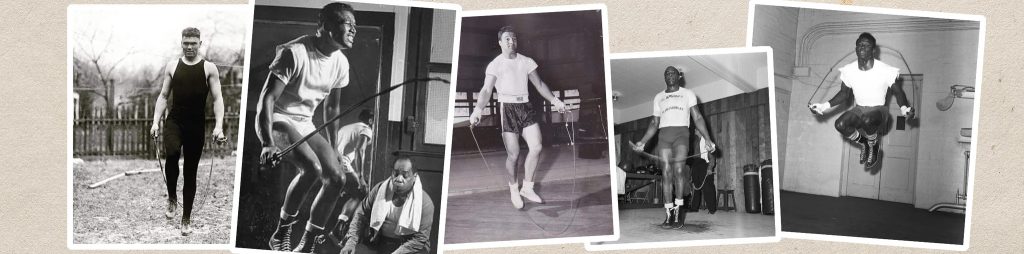
In the early 20th century, boxers began using ropes in training to improve conditioning, leg strength, and foot speed.
In the early 20th century, boxers began using ropes in training to improve conditioning, leg strength, and foot speed.

UBI-BSG-1101
Training Leather Boxing Gloves
- Best Boxing Gloves for Training— Durable synthetic leather, multi-layer padding, and wrist support for safe and powerful punches. Perfect for boxing, kickboxing, and MMA workouts.
- MMA & Boxing Training Gloves—Built for comfort and durability with impact-absorbing foam. Ideal for sparring, heavy bag training, and fitness sessions.
- Affordable Pro Boxing Gloves—Secure Velcro strap, sweat-resistant lining, and reinforced stitching for long-lasting performance. Great for beginners and pros.
- Boxing Gloves for All Levels— Whether you’re training, sparring, or competing, these gloves offer unmatched protection and an ergonomic fit.
- Kickboxing & Fitness Gloves—Versatile design for boxing, MMA, and cardio workouts. Stay safe and train longer with gloves that last.